The Short Answer
The shift is no longer marginal or experimental. According to the Nielsen India Digital Report 2025, 40 percent of Indian B2B companies moved from traditional social media agencies to AI-augmented providers between 2024 and 2026. The number was below 12 percent in 2022. The curve is steep and it is still rising.
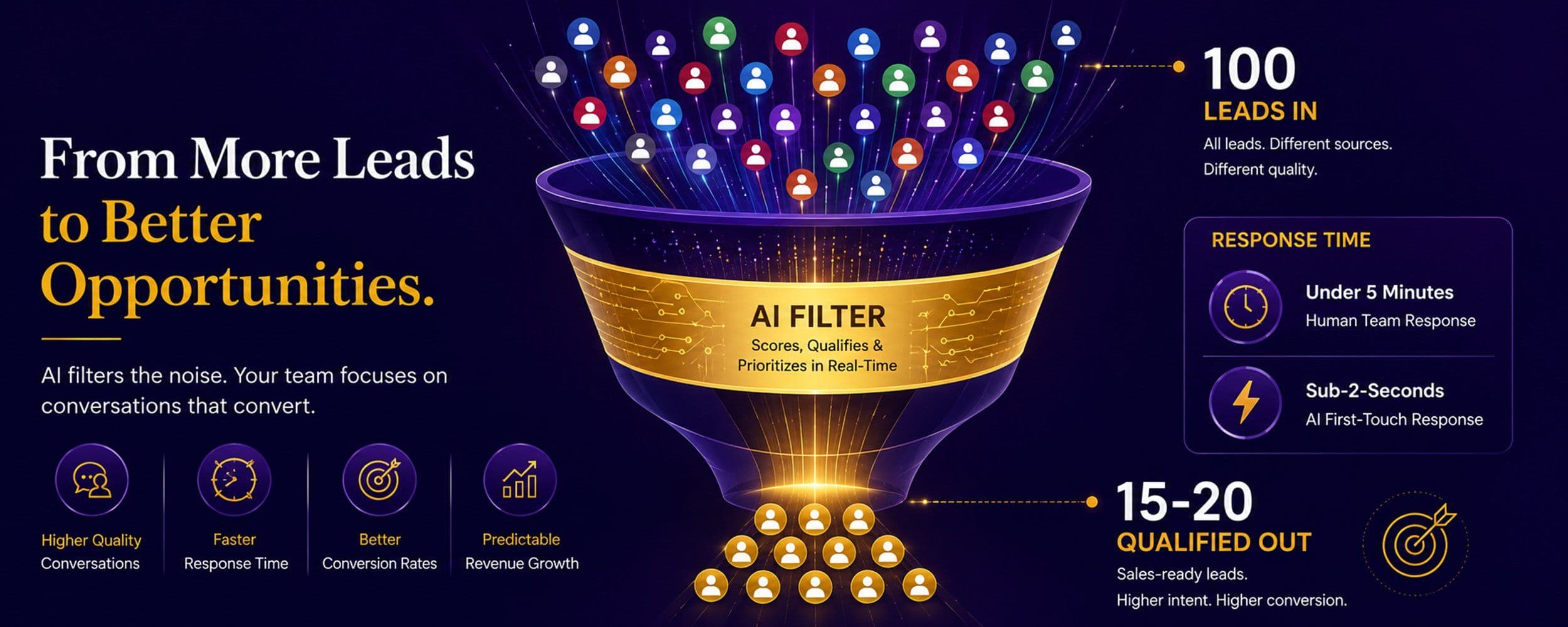
The commercial outcomes driving this shift are documented and consistent. Across Manufacturing, IT, Education, and Real Estate, Indian B2B businesses that switched to AI-augmented social media services reported average qualified lead volume from social channels increasing 2 to 4 times within the first six months. Cost per lead fell 40 to 60 percent over the same period. These are not outlier results from a handful of early adopters. They are averages from a statistically significant sample of Indian businesses making a deliberate infrastructure decision.
The gap between AI-augmented social media and traditional agency execution is no longer a difference of degree. It is a difference of business model. Traditional agencies are built around human expertise, monthly deliverable cycles, and backward-looking analytics. AI-augmented services are built around continuous data processing, dynamic optimisation loops, and forward-looking prediction. The operational architecture is fundamentally different, and the commercial outcomes reflect that difference directly.
This article is a structured comparison, not a promotional document. It covers what traditional agencies actually deliver, what AI-augmented services operationally do differently, how those differences play out sector by sector in the Indian market, and how to identify whether an agency claiming AI capability actually has it. The goal is to give Indian B2B decision-makers the information they need to evaluate their current social media investment objectively.
One important framing note before going further: AI-augmented social media does not eliminate the need for human strategic thinking, brand judgment, or creative expertise. It changes where those human inputs are applied. The question every Indian B2B company should be asking is not whether AI replaces their current agency. It is whether their current agency has the infrastructure to produce the commercial outcomes that the 40 percent of companies who have already made the shift are now achieving.
For context on how AI is reshaping paid channels alongside social, read how AI transforms performance marketing for scalable growth.
What Has Changed in Indian B2B Social Media
Open LinkedIn right now and look at the feeds of three B2B competitors in your sector. If they operate in Manufacturing, IT, Education, or Real Estate and they have been active on social media for the last 18 months, you may notice something different about the ones that are pulling ahead. The content is sharper. The targeting is more specific. The posting schedule is consistent in a way that suggests automation, not a social media manager manually scheduling posts each week. The topics they address feel remarkably current, as though they identified what their audience was searching for and searching about this week, not last quarter.
The companies that look different are not simply working harder or spending more on content production. They have changed the infrastructure behind their social media. The visible output, the posts and the videos and the articles, is just the surface layer. Underneath it is a data processing layer that most traditional agencies do not have and cannot replicate without fundamentally restructuring their operational model.
For 18 months to 2024, this shift was happening quietly in the background. Early adopters in Pune, Bengaluru, and Hyderabad were testing AI-augmented social media services and iterating. The results compounded. By late 2025 and into 2026, the competitive gap between AI-augmented and traditionally managed social media became visible enough that it started showing up in industry research and client conversations. The Nielsen India Digital Report 2025 formalised what practitioners had been observing for over a year.
The term AI-powered is now used loosely enough that it has become nearly meaningless without qualification. Some agencies apply it to mean they use a scheduling tool with a content suggestion feature. Others mean they have built an integrated stack that processes audience behaviour data continuously, runs dynamic targeting adjustments, and generates content briefs from structured intelligence. These are not comparable capabilities. The word AI describes neither of them accurately without further specification.
What AI-Powered Actually Means (and How the Term Is Misused)
AI-powered social media, properly defined, means the agency is using machine learning systems to continuously analyse audience engagement data, predict content performance, dynamically adjust targeting parameters, and attribute social interactions to pipeline outcomes. It does not mean using Canva AI for image generation, using a scheduling tool with a content prompt feature, or having one team member who uses ChatGPT to draft captions. When evaluating any agency claiming AI capability, ask specifically what data is being processed, at what frequency, and which commercial metrics the AI system is directly optimising.
Understanding this distinction is the first step to making an accurate evaluation of what you are currently paying for and what is commercially available.
The market-level shift has also changed the talent pool. The growth of AI-augmented social media services in India has attracted a new generation of practitioners who have never worked in a purely manual content calendar environment. They think in data loops rather than monthly deliverables. For Indian B2B companies, this talent dynamic means that the best strategic social media talent is increasingly concentrated in agencies that have built AI infrastructure, because those are the environments where this generation of practitioners wants to work.
“The competitive gap that was invisible 18 months ago is now visible in every sector. The companies building social media infrastructure today are the ones with the most share-of-voice in 2028.”
Traditional Social Media Agencies: What They Actually Deliver
Traditional social media agencies provide a defined set of services that have been the industry standard for ten years. It is important to describe these services accurately, because the case against traditional execution is not that these services are worthless. It is that they have a structural ceiling that limits how much commercial value they can generate for B2B companies.
The core service package from a traditional social media agency includes monthly content calendar planning, platform management across agreed channels, community engagement and comment monitoring, and monthly performance reports covering reach, impressions, engagement rate, and follower growth. Larger retainers typically add campaign management for paid social, creative production, and sometimes quarterly strategy reviews.
These are real services. Competent traditional agencies deliver them consistently and the output is professionally produced. The limitation is not competence. The limitation is architecture.
The strategy layer in traditional agency execution is inherently historical. Content calendars are built on what performed well last month, what the account manager observed in competitor feeds, and editorial judgment about what topics are likely to be relevant. There is nothing systematically wrong with this approach as a process. The problem is that it operates on a week-to-week or month-to-month cycle in a market environment where audience behaviour and platform algorithm signals shift continuously. By the time last month has been analysed and this month has been planned, a meaningful portion of the strategic input is already stale.
The analytics layer in traditional execution measures content performance, not pipeline contribution. Monthly reports tell you how many people saw a post, how many engaged with it, and whether your follower count moved. They do not tell you which posts were consumed by prospects currently evaluating your product category, which interactions preceded a website visit that converted to a lead, or which content types are statistically correlated with the profiles that eventually become clients. The gap between content performance data and pipeline data is structural. Without an integrated data layer connecting social engagement to CRM and conversion data, this gap cannot be closed regardless of how skilled the reporting team is.
Content production in traditional execution is a deliverable on a monthly checklist. The question the traditional agency answers is: did we produce the agreed number of posts this month? The question that drives commercial outcomes is: which content combinations, delivered to which audience segments, at which moments in their buying journey, generate pipeline? Traditional execution cannot answer the second question because the infrastructure required to answer it does not exist in a traditional agency model.
The Structural Limitation of Traditional Social Media Execution
Traditional agencies are operationally optimised to deliver content at scale within a defined monthly cycle. They are not operationally optimised to continuously process audience behaviour data, dynamically adjust targeting, or attribute social interactions to pipeline outcomes. This is not a criticism of individual agencies or practitioners. It is a description of a business model that was built before the data infrastructure required for closed-loop social media optimisation became commercially accessible.
There is one additional dimension of traditional execution worth naming explicitly: the account manager bottleneck. In most traditional agency relationships, the quality of strategic thinking applied to your account is directly correlated with how much senior attention your retainer commands. Smaller retainers get junior account managers following a template. Larger retainers get senior practitioners with genuine domain expertise. The quality variance across clients in a traditional agency is therefore large and highly sensitive to retainer size. AI-augmented systems apply the same analytical and optimisation capability regardless of retainer size, because the intelligence layer is infrastructure, not billable hours. This structural equity is particularly significant for Indian SMBs with Rs 50,000 to Rs 80,000 monthly budgets who have historically received template-level service from traditional agencies.
The result is that Indian B2B companies in the Rs 50,000 to Rs 1,50,000 monthly marketing budget range, which represents the majority of growth-stage companies in Pune and similar cities, are now able to access the quality of social media intelligence that was previously only available to companies with significantly larger marketing budgets. This is a genuine market access shift, not just a technological upgrade.
AI-Powered Social Media Services: What Is Operationally Different
The operational differences between AI-augmented and traditional social media services exist at every stage of execution. They are not cosmetic differences in the tools used. They are structural differences in how strategy is built, how content is prioritised, how targeting is managed, and how performance is measured. Each dimension is worth examining separately.
The clearest way to understand the operational difference is to follow a single content decision through both models. In a traditional agency, the decision to publish a LinkedIn article about supply chain resilience comes from a combination of editorial instinct, a client brief, and the observation that a competitor published something in the same category last week. In an AI-augmented agency, the same decision is preceded by data showing that engagement with supply chain content among procurement directors in the target segment has increased 280 percent in the last 14 days, that three specific subtopics within this category are showing outsized engagement-to-click-through ratios, and that the target company size has not been well served by the content currently available. The content that gets produced from this second starting point is different in quality, specificity, and commercial utility from what comes out of the first process.
Content and Strategy Intelligence
In traditional agency execution, the content calendar is built from editorial instinct and historical performance data. The account manager reviews last month, identifies what got engagement, checks competitor feeds, and plans forward from there. This is a rational process. It is also a process that begins with data that is already between four and eight weeks old by the time it influences content decisions.
In AI-augmented execution, the content planning process begins before any content is planned or briefed. AI systems analyse current audience behaviour data continuously: what your specific target segments are engaging with this week on LinkedIn and other platforms, which content formats are triggering the specific actions that precede conversion decisions, which topics are experiencing rising search and engagement volume in your industry right now. The content calendar that emerges from this analysis is a prediction of what will perform, not a summary of what did perform.
The practical difference is significant. A traditional content calendar might identify that engineering process improvement content performed well in March and schedule more of it in April. An AI-driven content strategy might identify that a specific sub-segment of your target audience is currently consuming content about sustainability compliance in manufacturing, that this topic has shown a 340 percent increase in engagement among procurement-level professionals in the last three weeks, and that your competitors have not yet addressed it. That is a targeting and timing advantage that manual processes cannot replicate.
The content brief produced from AI-driven intelligence is structurally different from a brief produced from editorial planning. It specifies the audience segment, the current trigger or pain point driving that segment to consume content in this category, the format that is producing the highest engagement-to-lead-action conversion rate for that segment right now, and the distribution sequence across platforms. The human writer or creative team still produces the content. What they produce it from is categorically more valuable than a monthly editorial calendar.
There is also a feedback quality dimension that compounds over time. In traditional execution, content performance data informs the next month's calendar in a loose qualitative way: this performed well, do more of it. In AI-augmented execution, every piece of content produces structured data that is immediately processed back into the content intelligence model, updating the prediction layer. The model gets more accurate every week. The content calendar six months into an AI-augmented engagement reflects six months of accumulated learning about what works for your specific audience in your specific market. A traditional content calendar six months into an engagement reflects six months of editorial experience, which is valuable but not the same thing.
“The content calendar is a prediction, not a plan. That single shift in how strategy is conceived is the primary source of the performance differential.”
Targeting and Analytics
Traditional paid social targeting is set manually at campaign setup and reviewed periodically, typically monthly or quarterly. An account manager defines the audience parameters, the campaign launches, and the parameters stay in place until the next review cycle. The optimisation that happens within platforms like LinkedIn Campaign Manager is algorithm-driven at the platform level, but the strategic targeting decisions, which company sizes, which job functions, which industries, which geographic clusters, are human decisions made on a periodic basis.
AI-driven targeting operates on a fundamentally different cycle. The system continuously analyses engagement signals, not at the level of likes and shares but at the level of which profile types are taking which actions after which content interactions. It identifies which combinations of company size, industry, seniority level, and content type are producing the highest ratio of qualified pipeline actions. It adjusts audience segmentation based on this data in near real time, reallocating budget toward the combinations that are converting and away from the combinations that are generating engagement without commercial follow-through.
A concrete illustration of the difference: suppose a traditional agency has set LinkedIn targeting to reach operations directors at manufacturing companies with 200 to 1,000 employees in Maharashtra. That targeting remains in place until the next quarterly review. An AI-augmented system running the same campaign might, after three weeks, identify that operations directors at companies with 500 to 800 employees in the automotive components sub-segment specifically are showing 4x the click-to-enquiry conversion rate of the broader target. It adjusts budget allocation toward this sub-segment within hours. The traditional agency discovers the same pattern at the next quarterly review, if the data analysis is detailed enough to reveal it. The AI-augmented system acts on it in days.
The targeting granularity available to AI systems on LinkedIn specifically has increased significantly in 2025 and 2026. The platform now provides engagement signals at a level of detail that makes probabilistic intent modelling feasible. AI-augmented agencies that have built the systems to ingest and process this data are operating with a targeting advantage that is not theoretically available to a manual account manager, regardless of how experienced or diligent they are.
The analytics layer in AI-augmented services connects specific content interactions to specific leads to specific pipeline stages. When a procurement manager at a manufacturing company in Pune engages with a specific piece of content and then completes a form fill on your website three days later, that interaction chain is captured, attributed, and fed back into the targeting model. Over time, the system develops a probabilistic profile of which social interactions are predictive of pipeline conversion. The content strategy and targeting decisions are continuously updated based on this data.
This is not how traditional social media analytics works. Traditional reporting tells you what happened to your content. AI-augmented analytics tells you which content interactions are leading indicators of commercial outcomes. The strategic value of that distinction is compounding. Every month of AI-driven analytics produces a more accurate model of what drives pipeline from social media for your specific business in your specific market context.
Response Speed
The standard content production workflow in a traditional social media agency moves through a defined sequence: brief is created, content is drafted, revisions are made, client approval is sought, content is scheduled, content goes live. For planned content in a monthly calendar, this process is manageable. For content that needs to respond to a current trend, a news event, a competitor announcement, or a sudden shift in what your target audience is engaging with, this workflow is too slow to be commercially useful.
The typical elapsed time from identifying a trend to publishing content in a traditional agency workflow is five to ten business days. By the time that content is live, the trend may have peaked and the engagement opportunity may have passed. In B2B social media, where the volume of content competing for attention is lower than in consumer categories, being first or early with relevant content on an emerging topic creates meaningful share-of-voice advantage. Traditional execution consistently misses these windows.
AI-augmented systems identify trend signals in real time. When engagement volume on a specific topic begins rising among your target audience segments, the system flags it, generates content briefs aligned with your brand voice and strategic priorities, and has draft content ready for human review within hours. The human review and approval step remains. What is eliminated is the lag between identification and brief creation, and the lag between brief and draft. The elapsed time from trend signal to published content in an AI-augmented workflow is typically measured in hours, not days.
The competitive compounding effect of this speed advantage is significant over a period of 12 to 18 months. A business that consistently publishes relevant content within hours of an emerging trend in their sector builds a LinkedIn presence and a search presence that a slower competitor cannot replicate simply by producing more content. Speed to relevance is a defensible competitive position in social media, and AI-augmented workflows are structurally faster at achieving it.
The Compounding Logic of Speed
Response speed in social media compounds in a way that monthly averages do not capture. A business that is consistently faster to relevant content than its competitors does not just win individual news cycles. Over 12 to 18 months, it builds a brand association with being current and credible that followers begin to expect and seek out. This is a durable positioning advantage, not just a tactical win.
Sector-by-Sector Impact for Indian Businesses
AI-augmented social media produces different outcomes in different sectors because the buyer behaviour patterns, content consumption habits, and commercial decision triggers vary significantly across industries. The general performance improvements documented in aggregate data translate into sector-specific advantages that are worth examining individually for Indian B2B companies evaluating this decision.
The sector analysis below is based on documented outcomes from Indian businesses in each category, drawing on the same Nielsen India Digital Report 2025 data referenced earlier in this article and supplemented by sector-specific research from CII, NHB, and VC Circle. Each sector has a distinct buyer profile, a distinct content consumption pattern, and a distinct set of commercial metrics by which social media effectiveness should be measured.
Manufacturing
Indian Manufacturing has traditionally found B2B social media difficult to operationalise for pipeline generation. The sales cycles are long, the decision-making units are complex, and the procurement process is driven by relationships and specifications rather than content consumption. This made social media feel like a brand awareness exercise with no clear connection to revenue outcomes. For a significant portion of Indian manufacturers, social media remained a box-checking exercise through 2022 and 2023.
AI-augmented social media changes this equation specifically because of how it surfaces procurement intent signals. Modern AI systems analyse LinkedIn activity patterns, content engagement sequences, company research behaviour, and platform interactions in combination to identify when procurement managers, plant heads, and supply chain directors are in an active vendor evaluation phase. These are not guesses. They are probabilistic signals derived from engagement patterns that correlate with active buying behaviour.
When a procurement director at an automotive components manufacturer in Pune begins consuming content about supplier qualification standards, quality management systems, and material cost benchmarking within a two-week window, that engagement pattern is a signal. AI-augmented systems identify it and trigger content delivery at the exact moment when that buyer is forming their vendor shortlist. Traditional social media posting schedules do not and cannot operate with this level of buyer-stage awareness.
The practical result for Manufacturing clients using AI-augmented social media in India has been documented: response to RFQs sourced from social media channels increased 2.8 times on average. More importantly, the quality of those RFQs improved because the targeting ensured the prospects engaging with the content matched the ideal customer profile before they ever submitted an enquiry.
The implication for Indian manufacturers is that social media has moved from being a brand awareness channel with no measurable pipeline contribution to a lead qualification channel that operates earlier in the buying cycle than the RFQ itself. Manufacturers that integrate AI-augmented social media into their overall sales development process are finding that by the time a qualified prospect submits an RFQ, the manufacturer already has a documented engagement history with that prospect that informs the quality and relevance of the response. The social media channel is no longer separate from the sales process. It is an earlier stage in it.
For manufacturing companies evaluating their broader social media strategy, the essential guide to social media marketing dos and donts covers the foundational principles that apply across all sectors.
IT and SaaS
For Indian IT services companies and SaaS businesses, the primary social media challenge is thought leadership at scale. In a sector where every company claims to be innovative, differentiated, and customer-focused, the content volume required to establish genuine thought leadership is higher than most teams can produce through manual processes. Executive and founder profiles sit underpopulated. The company LinkedIn page publishes content irregularly. The gap between what the company knows and what its market can see from the outside is significant.
AI makes thought leadership at scale feasible in a way it simply was not before. Rather than asking executives to individually draft LinkedIn articles in between client calls and business development, AI-augmented workflows create a structured intelligence layer: inputs from the executive include their current perspective on a technical or strategic topic, their recent client conversations, and their view on market direction. The AI processes these inputs alongside current audience engagement data and produces content variants across formats, long-form articles, short observation posts, commentary on industry developments, and visual explainers, each optimised for the platform and the current engagement environment.
The distribution layer in AI-augmented IT social media is equally important. Content from an IT services company that is genuinely relevant to a specific technical audience needs to reach that audience across LinkedIn, developer communities, industry publications, and sector-specific online forums simultaneously. AI-augmented distribution handles this across channels with coordinated timing, ensuring that the same core intellectual contribution reaches its full potential audience rather than being limited to the company page followers who happen to be online when a post is published.
Indian IT companies using AI-augmented social media have documented consistent outcomes in qualified inbound: average inbound leads from social channels increased 3.1 times, and the proportion of inbound leads coming from target company profiles, the accounts they actively wanted to win, increased from 22 percent of inbound to 61 percent. This is the thought leadership compounding effect: consistent, credible, well-distributed content attracts the specific audience you are trying to reach rather than a general technology audience.
The Thought Leadership Compounding Effect
Thought leadership on LinkedIn does not scale linearly. The first six months of consistent, high-quality content builds a foundation. From month seven onward, the algorithm rewards established credibility with greater organic distribution, followers begin sharing content within their networks, and inbound enquiries from target account profiles begin increasing. AI-augmented execution reaches this compounding phase faster because content quality is higher, posting consistency is maintained, and the content topics are selected based on what the target audience is actually engaging with rather than editorial guesswork.
For IT and SaaS companies in Pune specifically, the opportunity is particularly significant because the local competitive landscape is dense but the average quality of social media execution remains low. The companies that invest in AI-augmented social media now are building a compounding advantage over competitors who are still operating on manual monthly content calendars.
A practical note on implementation for IT and SaaS companies: the most common point of failure in thought leadership social media programs is the sourcing of raw intellectual input from senior practitioners. AI systems can process inputs, generate content variants, and optimise distribution, but they cannot substitute for the genuine expertise and perspective that makes thought leadership credible. The most effective AI-augmented thought leadership programs build a structured input process that captures genuine expert perspective efficiently, typically through short structured interviews or audio recordings that are then processed and amplified by the AI layer.
Pune-based IT and SaaS businesses can also reference social media marketing for companies in Pune in 2026 for local market context.
Education
Social media in Indian Education is acutely timing-sensitive in a way that distinguishes it from most other sectors. Admission enquiry windows are concentrated and predictable: students and parents research institutions and programmes intensively for two to four weeks before shortlists solidify and applications are submitted. Outside these windows, the same content that drives enquiries during peak research phases produces little commercial response. A social media strategy that ignores this cycle wastes budget during off-peak periods and misses the peak window.
AI-driven audience modelling changes how education institutions can operate within this cycle. Rather than maintaining a uniform posting schedule year-round and hoping to be visible when prospects enter research mode, AI-augmented systems identify which prospects are in active research phase based on engagement history, search behaviour signals, platform activity patterns, and interaction sequences. A student who has engaged with three pieces of content about MBA programmes, visited the programme page twice, and started following two alumni profiles in the last ten days is exhibiting a behavioural pattern that is predictive of an active application decision. AI systems surface these signals in real time.
The content delivered to prospects identified as being in active research phase is also different from general awareness content. AI-augmented execution delivers content tailored to the specific programme of interest, the specific concerns that drive hesitation at that decision stage, and the specific comparisons the prospect is likely making. A prospect showing signals of comparing two business schools receives content that addresses the differentiation factors most relevant to their observed interest profile. A prospect showing signals of evaluating financing options receives content about scholarship availability and ROI from the programme.
Education institutions in India using AI-augmented social media have documented a consistent pattern: ratio of qualified enquiries to total enquiries increased significantly, meaning the percentage of forms filled by genuinely interested, programme-fit prospects went up while the total volume of unqualified enquiries went down. Cost per enrolled student fell by an average of 47 percent. The quality improvement matters as much as the cost improvement because it reduces the burden on admissions teams who currently process large volumes of enquiries from poorly matched prospects.
There is a longer-term value dimension in education that AI-augmented social media is particularly effective at building: alumni community engagement. Existing alumni are among the most credible voices a higher education institution has, and their activity on social media directly influences how prospective students perceive the institution. AI-augmented strategies include systematic alumni content amplification, identifying alumni who are posting about career progression or professional achievements, and coordinating light-touch engagement that builds the institution's social proof continuously between peak admission windows.
Real Estate
Indian Real Estate buyer behaviour on social media has a specific pattern that AI is particularly effective at exploiting. Property purchase is a high-involvement decision with a research phase that typically lasts between two and twelve months. During this phase, buyers consume large volumes of content: project comparisons, pricing analysis, location analysis, construction quality assessments, financing information, and developer reputation research. The engagement footprint a buyer leaves during this research phase is rich with intent signals.
AI analysis of browsing behaviour, property portal interaction data, social media engagement patterns, and platform activity allows Real Estate brands to identify buyers who are in the active consideration phase with high confidence. A person who has engaged with three property projects in a specific micro-market, searched for home loan information twice in the last month, and clicked through on two pricing comparison posts is exhibiting a buying intent pattern that is statistically distinguishable from a person who is casually browsing property content.
When AI systems identify a prospect in active consideration phase, the content strategy shifts from awareness to facilitation. Rather than delivering the same general project awareness content that goes to the full audience, AI-augmented targeting delivers highly specific content to the identified buyer: current pricing context and how it compares to the market, specific project features that match the engagement history, financing information structured around the price range the buyer has been engaging with, and comparison content that positions the developer favourably against the alternatives the buyer has been researching.
The timing dimension in Real Estate is particularly valuable. Property shortlists form in compressed windows. A buyer in active consideration phase for an apartment in Pune's Hinjewadi micro-market is most receptive to specific, differentiated content during the two to three weeks when they are actively comparing options and forming a shortlist. AI-augmented systems identify when a prospect is in this window and concentrate content delivery during it. Traditional agencies posting to a general audience on a monthly calendar cannot create this kind of buyer-stage targeting.
Indian Real Estate developers also have a post-purchase social media opportunity that AI-augmented systems are uniquely positioned to exploit: referral network activation. Buyers who have recently completed a purchase are statistically the most likely social media connections to influence others currently in the research phase. AI systems identify recently completed buyers within the social network, trigger targeted content that makes sharing easy and rewarding, and systematically amplify positive ownership and construction update content to the buyer's network at the moment their credibility as a recommender is highest. Traditional agencies do not have the data infrastructure to execute this referral amplification loop.
3 Things an AI Agency Can Do That a Traditional Team Cannot
There are capabilities that AI-augmented social media services have that are not available to traditional agencies regardless of team size, budget, or talent level. These capabilities are not about AI being smarter than humans. They are about processing speed, data volume, and execution cycles that are beyond what human teams can physically achieve.
It is worth acknowledging upfront that this is not a critique of talent. Some of the most skilled social media strategists in India work at traditional agencies and produce genuinely excellent content and community work. The capabilities described below are not about the quality of individual practitioners. They are about what is structurally possible given the tools and data infrastructure available.
First: Analyse 10,000-plus content engagement signals per day to predict optimal content type, format, and timing.
A well-resourced traditional social media team might review performance data for 20 to 30 content pieces per week. With high diligence, they might identify patterns across 100 to 150 data points per month. An AI system processing the same client account processes 10,000 or more engagement signals per day, including not just which posts got likes and comments but which content pieces were consumed by which profile types, which interactions preceded website visits, which engagement sequences correlate with later conversion actions, and which topics are producing rising or falling engagement among specific audience segments. The volume of data processed and the frequency of analysis is categorically different from what human analysts can achieve.
The practical outcome is that content strategy recommendations from AI-augmented systems reflect a continuously updated, statistically robust picture of what is working. Content strategy recommendations from traditional teams reflect a sample of data reviewed periodically. When market conditions shift, when a new topic emerges, when a platform algorithm update changes what content gets distributed, the AI-augmented system identifies and responds to the change within days. The traditional team identifies and responds within weeks or months.
The volume of signal processing also enables AI systems to identify negative patterns with speed and precision that human analysts cannot match. If a content type that has been performing well begins declining in its engagement-to-conversion ratio, the AI system flags the decline within days and the content strategy adjusts. A traditional team reviewing monthly data might continue producing the same content type for another six to eight weeks before the decline becomes apparent in aggregate reporting. In a fast-moving market, weeks of delayed signal response translate directly into wasted budget and missed pipeline opportunity.
Second: Dynamically reallocate budget across platforms within 4-hour windows based on live conversion signals.
Paid social budget allocation in traditional execution is set at campaign setup and adjusted periodically. If LinkedIn is outperforming Instagram for a specific audience segment on a specific day, the budget continues to be distributed according to the original plan until the next optimisation review. A week of suboptimal budget allocation is the routine cost of traditional execution cycles.
AI-augmented budget management continuously monitors conversion signals across platforms and reallocates budget toward the combinations producing pipeline in near real time. Within a 4-hour window, budget can shift from a LinkedIn audience segment showing declining conversion rates to an audience segment on the same platform that is showing rising qualified engagement. Over the course of a month, this continuous micro-optimisation produces significant efficiency gains. The Rs 1,00,000 monthly budget for a B2B company using AI-augmented paid social produces materially more qualified pipeline than the same Rs 1,00,000 managed with periodic human review because every rupee is consistently being pushed toward the highest-converting combination available at that moment.
Third: Attribute specific content interactions to pipeline stages and revenue outcomes.
The attribution problem in social media is one of the most persistent frustrations for B2B marketing leaders: social media generates activity, but the connection between specific social media investments and specific revenue outcomes is difficult to demonstrate. Traditional reporting measures what social media does, not what it contributes to revenue. This makes social media budgets perpetually vulnerable to cuts because the commercial case for them is always partly qualitative.
AI-augmented analytics closes this gap by connecting the data layers that traditional reporting leaves disconnected. When a specific LinkedIn post is consumed by a prospect who then visits a specific page on the company website, submits a form, is qualified by the sales team, and moves through the pipeline to a closed deal, that entire interaction chain is captured and attributed. The social media team can show which content types, which audience segments, and which platform combinations are statistically correlated with pipeline contribution and revenue outcomes. This transforms the social media budget conversation from a qualitative discussion about brand awareness to a quantitative discussion about pipeline ROI.
For Indian B2B companies whose marketing budgets are under increasing scrutiny from finance functions, this attribution capability is commercially valuable beyond its direct optimisation benefit. The ability to demonstrate that Rs 1,00,000 invested in social media produced Rs 8,00,000 in qualified pipeline is a fundamentally different conversation than showing that the same investment produced 45,000 impressions and a 3.2 percent engagement rate. AI-augmented attribution transforms social media from a cost centre with uncertain returns to a measurable revenue function with a documented ROI.
The Operational Reality of Each Capability
These three capabilities are not features you can purchase and switch on. They require underlying data infrastructure: CRM integration so social interactions can be connected to pipeline data; conversion tracking that captures the full interaction chain from social to website to form fill; and a clean data model that allows AI systems to attribute outcomes correctly. An agency claiming these capabilities without discussing the data infrastructure requirements to support them is either oversimplifying what is involved or overstating what their system actually does.
Cost Comparison and ROI
The cost comparison between traditional and AI-augmented social media services is straightforward at the retainer level but requires additional context to interpret correctly. Traditional agency retainers for Indian B2B companies covering social media strategy, content production, platform management, and monthly reporting typically range from Rs 30,000 to Rs 80,000 per month depending on the number of platforms, content volume, and agency reputation. This range covers the majority of mid-tier agency engagements for companies with 50 to 500 employees.
AI-augmented social media services in the Indian market in 2026 typically range from Rs 50,000 to Rs 1,50,000 per month. The premium over traditional retainers reflects the infrastructure cost of AI systems, the data engineering required to build the analytics and attribution layers, and the specialised expertise required to manage and interpret AI-driven workflows. The headline premium appears significant: an AI-augmented service at Rs 1,00,000 per month costs 25 to 233 percent more than a traditional service at Rs 30,000 to Rs 80,000 per month.
This comparison is commercially misleading without cost-per-qualified-lead context. If a traditional agency at Rs 60,000 per month generates 15 qualified leads from social channels per month, the cost per qualified lead is Rs 4,000. If an AI-augmented service at Rs 1,00,000 per month generates 48 qualified leads per month, the cost per qualified lead is approximately Rs 2,080, a 48 percent reduction in unit economics despite a 67 percent increase in retainer cost. The relevant comparison for a B2B company evaluating this decision is not retainer cost. It is cost per qualified lead and cost per acquired client.
The payback period for the premium investment in AI-augmented services is consistently documented at 60 to 90 days from the point when the AI systems have sufficient data to optimise effectively. The first 30 to 45 days of an AI-augmented engagement are data accumulation and baseline establishment. From day 45 onward, the optimisation loops begin producing measurable CPL improvement. By day 90, the majority of clients are operating at cost per qualified lead levels that are 40 to 60 percent below their previous baseline. The premium has paid for itself.
For Indian B2B companies evaluating this decision, the relevant financial question is not whether AI-augmented social media costs more per month than traditional. It does. The question is whether the improvement in cost per qualified lead and increase in qualified lead volume generates a positive return on the incremental investment within a commercially acceptable timeframe. The documented evidence from the Indian market in 2025 and 2026 consistently suggests it does, typically within the first quarter.
One additional financial consideration that is often overlooked in this comparison is the cost of inaction. Every month a company operates on a traditional social media execution model while competitors operate on AI-augmented models is a month in which the competitive compounding effect is working against it. Share of voice, thought leadership credibility, and LinkedIn algorithmic advantage all compound over time. The cost of rebuilding these from a deficit position is higher than the cost of investing in the right infrastructure now.
Indian B2B companies that frame the AI-augmented social media decision purely as a budget comparison, traditional retainer versus AI-augmented retainer, are evaluating the wrong variable. The correct evaluation framework compares cost per qualified lead, qualified lead volume, and the trajectory of competitive position over a 12-month horizon.
For companies in Pune specifically evaluating the AI versus traditional agency decision, the comparison guide for Pune businesses on AI social media versus traditional agencies provides local market benchmarks.
5 Questions to Ask Any Agency to Determine Real AI Capability
The gap between agencies that genuinely have AI capability and agencies that have rebranded traditional execution as AI-powered is significant. The tell-tale signs are not always visible in an agency presentation or a capabilities document. They emerge in the answers to specific questions that cannot be answered with a prepared slide.
Before investing time in a full agency evaluation, it is worth applying a simple pre-filter: ask the agency for a sample attribution report from a current client, with identifying information removed. If the agency cannot produce such a document within 24 hours, the attribution capability does not exist at the level of operational routine. A genuinely AI-augmented agency produces these reports continuously and can pull a sample rapidly. If production of a sample report requires a week of preparation, the infrastructure is not what it is being represented as.
The five questions below go deeper than the pre-filter. They are designed to be used in a structured agency evaluation conversation where you are comparing two or three agency options side by side. The answers, or the failure to answer, are more diagnostic than any capability presentation the agency will prepare in advance.
Question 1: What data sources does your AI system process, at what frequency, and what is the output of that processing?
A genuine answer describes specific data inputs: LinkedIn engagement data, website interaction data, CRM pipeline data, platform conversion signals. It describes a specific processing frequency: continuous, hourly, or daily. It describes a specific output: content brief updates, audience segment adjustments, budget reallocation recommendations. A vague answer that references AI and data without specifying sources, frequency, or outputs indicates the capability does not exist in the form being described.
Question 2: How does your system connect social media engagement to pipeline contribution? Show me an example attribution report.
If the agency cannot produce an attribution report that connects specific social media interactions to specific pipeline stages, they do not have closed-loop attribution. The correct response to this question involves showing actual data connecting content engagements to lead records to pipeline values. If the response involves explaining why social media attribution is inherently difficult and then showing reach and engagement metrics, the attribution capability does not exist.
Question 3: What was the last major content strategy adjustment your AI system recommended and why?
This question cannot be answered from a prepared deck. It requires the account team to describe a specific, recent event: what signal the system identified, what the recommended adjustment was, what content change was made, and what the measured outcome was. Vague or generic answers indicate that the content strategy decisions are being made by humans using editorial judgment rather than by AI systems processing live data.
Question 4: How quickly can you publish content in response to a breaking development in our industry?
This tests whether the speed advantage of AI-augmented workflows actually exists in practice. An agency with genuine AI capability will describe a process: trend signal identified by the system, content brief generated automatically, human review cycle of two to four hours, publication same day. An agency without this capability will describe a standard production process that takes several days, possibly with language suggesting they can rush it if needed.
Question 5: What CRM and analytics integrations do you require from our side to implement properly?
An agency with genuine AI attribution capability will have specific integration requirements: CRM access to connect lead records, conversion tracking setup, website analytics configuration. If the agency does not require any integration work and does not ask about your CRM setup, it is because their system does not actually connect to your commercial data. An AI social media system that does not integrate with your CRM cannot attribute pipeline outcomes and therefore cannot deliver the commercial measurement capability that defines AI-augmented execution.
The Tell-Tale Sign of a Traditional Agency Claiming AI Capability
If an agency says they use AI in their workflow but cannot answer Questions 2 and 5 specifically, they are applying the term to tools like generative image creation, caption drafting assistance, or scheduling automation. These are useful productivity tools. They are not AI-augmented social media in the commercially meaningful sense. The agency's underlying execution model is traditional: manual strategy, monthly cycles, content performance metrics, no pipeline attribution.
Beyond these five questions, there is one additional signal worth paying attention to during an agency evaluation: how does the agency describe its own performance metrics? A traditional agency will talk about reach, impressions, engagement rates, and follower growth. An AI-augmented agency will talk about qualified leads, pipeline contribution, cost per qualified lead, and attribution. The metrics an agency uses to describe its own value are a direct reflection of what its infrastructure is capable of measuring. If the metrics are content-centric, the capability is content-centric.
The evaluation process is worth taking seriously because the consequences of choosing incorrectly are compounding. An agency relationship typically runs 12 to 24 months. 12 to 24 months of building on a traditional infrastructure while competitors build on AI-augmented infrastructure creates a gap in share-of-voice, thought leadership credibility, and pipeline data that takes significant time and investment to recover from. The evaluation decision is not just a monthly budget decision. It is a competitive positioning decision with a multi-year horizon.
Sources and Data
The evidence assembled in this article points in one direction: AI-augmented social media is not a premium option for companies with large marketing budgets. It is a commercial necessity for any Indian B2B company that intends to compete seriously for qualified pipeline from social channels over the next three years. The 40 percent of Indian B2B companies that have already made this shift are not early adopters chasing technology novelty. They are pragmatic businesses that identified a gap in commercial performance and made a structural decision to close it.
The trajectory from here is clear. As AI-augmented social media becomes the baseline expectation for B2B marketing execution in India, the question will no longer be whether to adopt it. It will be whether you adopted it early enough to build a compounding advantage, or late enough that you are spending the next 18 months recovering lost ground. The data in this article is drawn from the period when the gap was still closable. That window does not stay open indefinitely.
The six sources cited below are the primary research and industry surveys from which the data in this article is drawn. Readers wanting to verify specific statistics or explore methodology are encouraged to review the original publications directly.
1. Nielsen India Digital Report 2025 — India B2B social media agency adoption survey, AI-augmented vs traditional agency market share, qualified lead volume improvements, cost per lead benchmarks across Manufacturing, IT, Education, and Real Estate sectors.
2. Internet and Mobile Association of India (IAMAI) — India Digital Marketing Report 2025: AI tool adoption among Indian marketers, percentage actively deploying AI in campaigns, AI marketing tools market size in India.
3. LinkedIn B2B India Report 2025 — B2B buyer behaviour on LinkedIn India, thought leadership influence on purchase decisions, procurement manager engagement data, executive content consumption patterns.
4. Confederation of Indian Industry (CII) Digital Business Survey 2025 — Manufacturing sector digital marketing adoption, procurement manager content influence data, vendor evaluation digital touchpoints, social media influence on supplier shortlisting.
5. National Housing Bank (NHB) Digital Consumer Survey 2025 — Real estate buyer digital behaviour, social media influence on property shortlisting, content consumption patterns during active buyer consideration phase.
6. Indian Ed-Tech Market Cost Benchmarking Report 2025 (VC Circle / Redseer) — Education sector social media cost benchmarks, cost per enrolled student comparisons between AI-augmented and traditional social media execution, qualified enquiry ratio improvements.